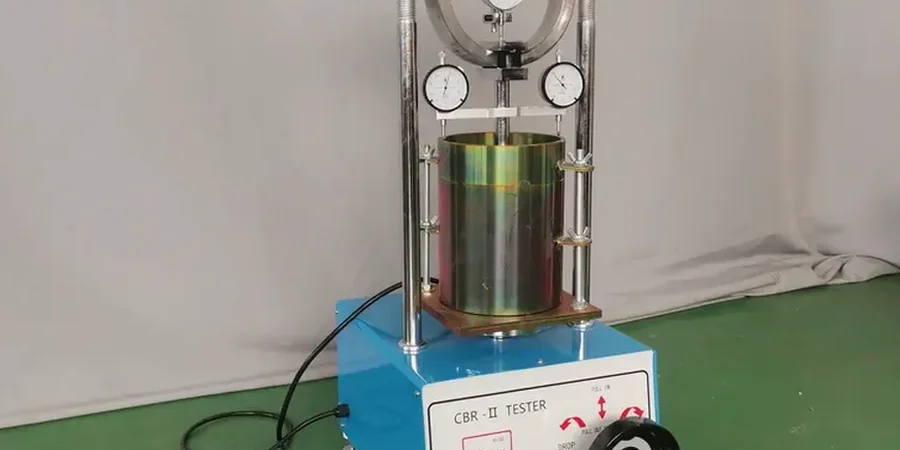
Carlow’s expansion east of the Barrow has pushed roads and industrial yards onto ground that tells a story – glacial tills over limestone, softened by centuries of a high water table. When the county council widened the N80 approach, the biggest head-scratcher wasn’t the alignment; it was whether the subgrade could handle 20 years of HGV loading without rutting. That’s where a laboratory CBR test stops being a routine index and starts being cheap insurance. We run soaked CBR specimens at the moisture condition that actually exists under Carlow’s roads, not some textbook dry density. The result is a strength value you can plug straight into a TII pavement design, without the guesswork. Before staking out the car park layout, it often pays to run a few in-situ permeability measurements nearby – if the drainage is wrong, even a solid CBR will pump fines up into the stone layer within two winters.
The soaked CBR value tells you what your pavement will face in February, not what it looks like during a dry August construction window.
Methodology applied in Carlow
Local geotechnical conditions in Carlow
Compare two sites just 3 km apart: one on the gravel terrace north of the River Barrow near the Institute of Technology, and another on the low-lying silty clays south of the railway line toward Leighlinbridge. The gravel terrace might give you a soaked CBR of 15–20% without breaking a sweat. The silty clay, after a wet winter and some construction trafficking, can drop below 2% – and that’s the difference between a standard 200 mm capping layer and a 500 mm stabilised platform that nobody budgeted for. The laboratory CBR test exposes this gap before the first lorry of stone arrives. We’ve seen Carlow industrial units where the access road specification was copied from a Dublin job, and within 18 months the surface was a network of crocodile cracks because the subgrade CBR was a third of what was assumed. For pavement designers working on the commuter corridor toward Dublin, integrating our CBR data with a flexible-pavement design review catches these mismatches at tender stage, not during the defects liability period.
Our services
Every laboratory CBR test we run in Carlow feeds into a practical pavement recommendation – here’s how we structure the work.
Soaked CBR for road subgrades
Three-point moisture series, 96-hour soak, surcharge applied – we test material from your boreholes at the density the contractor will actually achieve, not a theoretical maximum.
CBR correlation with site investigation data
We pair laboratory CBR values with our spt-drilling logs from the same borehole to build a continuous strength profile with depth, giving your pavement designer data at every chainage.
Questions and answers
What does a laboratory CBR test cost in Carlow, and what affects the price?
A single CBR point with three moisture specimens typically runs between €110 and €200, depending on whether you need the full 96-hour soak and surcharge setup. Bulk pricing kicks in at five points or more, which is common for road schemes where we test at every 200 m of alignment. The main cost driver is specimen preparation time – if your material needs to be dried, crushed, and re-compacted to a target density, that adds lab hours compared to testing an undisturbed sample.
Why soak the specimen for four days – isn't the in-situ moisture enough?
Because Carlow's water table rises fast between October and March. A specimen tested at natural moisture in August might give you a CBR of 18%, but after four days submerged it can drop to 5% if the fines are moisture-sensitive. The 96-hour soak in BS 1377-4 simulates the worst-case saturation the subgrade will see over the pavement's design life, and TII design methods explicitly require the soaked value for capping layer thickness calculations.
How many CBR points do I need for a housing estate access road in Carlow?
For a typical residential access road under 300 m, we recommend a minimum of three test points taken from different borehole locations or trial pits – ideally one at each end and one in the middle. If the site investigation logs show the subgrade material changes (say from gravelly till to silty clay), you'll want at least one CBR per material type. This gives your pavement designer enough data to avoid over-designing the whole road for the weakest spot, or worse, under-designing it and facing premature failure.