In-situ testing forms the backbone of reliable geotechnical site investigation across Carlow, providing direct measurements of soil and rock properties without the disturbance inherent in laboratory sampling. This category encompasses a suite of field-based methods designed to evaluate ground conditions in their natural state, from density and strength to permeability and deformation characteristics. For a county undergoing significant residential expansion, infrastructure upgrades, and commercial development, the data gathered through these tests directly informs foundation design, earthworks specifications, and risk mitigation strategies. Without accurate in-situ data, projects face increased uncertainty, potentially leading to over-designed and costly foundations or, conversely, to inadequate ground support with serious long-term consequences.
Carlow's geological landscape presents a varied subsurface profile that demands careful investigation. Much of the county is underlain by Carboniferous limestone, with glacial tills and fluvioglacial sands and gravels deposited during the last ice age dominating the near-surface strata. The River Barrow and its tributaries have carved alluvial corridors where soft silts and clays can extend to significant depths, while elevated areas may feature thin drift cover over weathered bedrock. This variability means that ground conditions can change dramatically across a single site, and desk-study assumptions rarely suffice. In-situ testing bridges this gap, providing spatially relevant data that captures the true heterogeneity of these glacial and alluvial deposits.
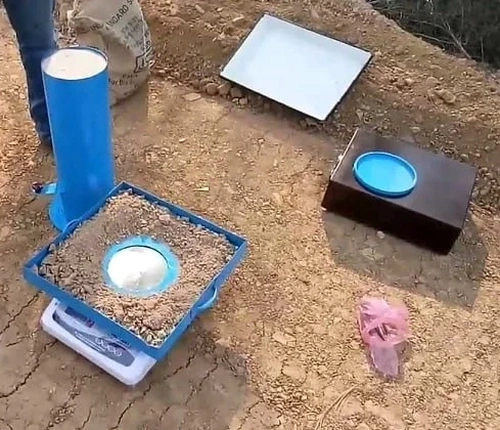
Irish and European standards govern in-situ testing practice in Carlow. The relevant framework includes IS EN ISO 22476 for field testing, alongside the overarching requirements of Eurocode 7 (IS EN 1997-2) for ground investigation and testing. These documents specify equipment calibration, procedural rigor, and reporting standards that ensure results are defensible and comparable. For routine tasks such as a field density test (sand cone method), adherence to these norms is critical for verifying compaction levels in engineered fills, road sub-bases, and pipeline bedding. The National Annexes to the Eurocodes, along with guidance from Engineers Ireland and the Institution of Civil Engineers, further refine the application of these standards to Irish ground conditions.
The range of projects requiring in-situ testing in Carlow is broad. Residential developments on greenfield sites demand thorough characterization of bearing capacity and settlement potential, particularly where glacial clays are encountered. Road and bridge projects, such as the Carlow Southern Relief Road, rely on continuous assessment of subgrade strength and aggregate quality. Commercial and industrial builds, including the extension of business parks and agri-food facilities, must verify ground conditions for heavily loaded slabs and vibration-sensitive equipment. Even smaller-scale works like agricultural sheds, retaining walls, and domestic extensions benefit from targeted testing to avoid costly surprises during excavation. Each project type leans on different combinations of tests, but all share a common need for reliable, site-specific data.
Available services
Questions and answers
What is the difference between in-situ testing and laboratory testing of soils?
In-situ testing measures soil properties in their natural state without removing samples from the ground, preserving factors like stress history, moisture content, and structure. Laboratory testing, while offering controlled conditions, inevitably disturbs samples during extraction and transport. In-situ methods often provide continuous profiles and can test materials that are difficult to sample, such as loose sands or soft clays, giving a more representative picture of ground behaviour.
When is in-situ testing required under Irish building regulations?
In-situ testing is required whenever ground conditions must be characterised for structural design, as mandated by Eurocode 7 (IS EN 1997-2) and the Building Regulations Technical Guidance Document A. Any project requiring planning permission in Carlow that involves foundations, retaining structures, or significant earthworks will typically need a site investigation incorporating appropriate in-situ tests to demonstrate compliance with safety and serviceability limit states.
What types of ground conditions in Carlow are most challenging for in-situ testing?
The most challenging conditions include the soft alluvial silts and clays along the Barrow Valley, which can be difficult to penetrate without disturbance, and the variable glacial tills containing cobbles and boulders that may obstruct testing equipment. Weathered limestone bedrock with pinnacles and solution features also presents interpretation difficulties, requiring a combination of methods to build a reliable ground model across a site.
How many in-situ tests are typically needed for a standard housing development site?
The number of tests depends on site size, geological variability, and the investigation objectives outlined in the geotechnical desk study. Eurocode 7 guidance suggests investigation points at 15 to 40 metre spacings for multi-story residential schemes, with each point potentially including several in-situ test types such as standard penetration tests, dynamic probing, or density assessments, though a specific investigation plan should be designed by a qualified geotechnical engineer.