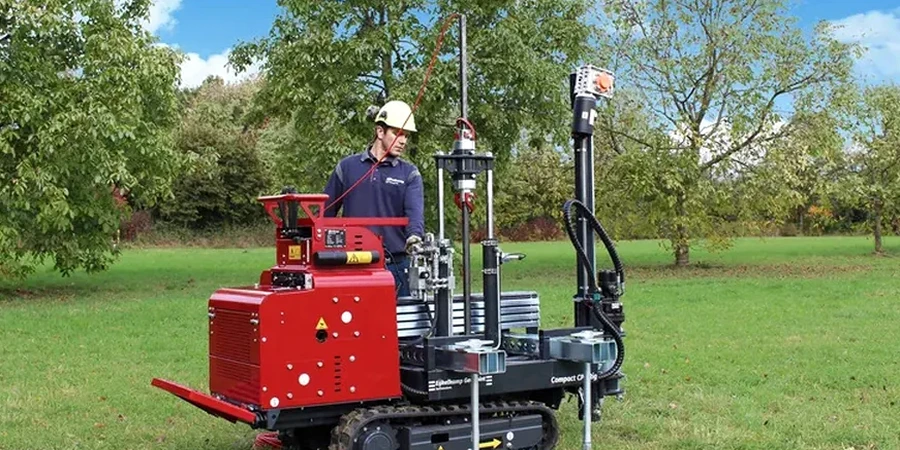
The River Barrow cuts straight through Carlow town, and with it comes a mixed bag of subsurface conditions that demand more than a standard borehole log. We see compact limestone gravels sitting beneath soft silty clays, and the transition zone is where most footing designs get it wrong. A CPT test gives you a continuous resistance profile that picks up these interfaces to within a few centimetres, which is exactly what you need when working within the floodplain constraints of the Barrow Valley. Over the years our team has pushed cones from Tullow Road down to the Carlow College area, and the stratigraphy changes faster than most engineers expect. For projects where CPT refusal is reached early in dense gravels, we often combine the cone data with SPT drilling to extend the investigation depth and recover samples from the stiffer layers.
In Carlow's glacial tills and river gravels, a CPT log reveals the thin soft seams that a standard SPT sampler blows straight through – and those seams control settlement behaviour.
Methodology applied in Carlow
Local geotechnical conditions in Carlow
The single most expensive mistake we see on Carlow sites is assuming that granular river deposits are consistently dense with depth. The Barrow has shifted course repeatedly over centuries, leaving buried channels of loose saturated sand that show up as sharp drops in cone resistance – and those lenses are precisely where bearing capacity collapses happen during excavation dewatering. Without a continuous CPT trace, a borehole log spaced at 1.5-metre intervals can miss a 400 mm loose seam entirely. We have been called in to re-test sites where pad footings were poured on what looked like competent gravel, only to find a thin soft layer at 2.8 metres that explained the differential settlement. A test pit inspection can sometimes confirm these features visually at shallow depth, but below 4 metres the cone is really the only reliable tool for catching them. The risk is not theoretical; it shows up in crack surveys six months after handover.
Our services
Our CPT service in Carlow covers the full workflow from site access assessment through to engineering parameter derivation. Every test is supervised by a geotechnical engineer who knows the local geology.
Piezocone CPTu Profiling
Standard service with pore pressure measurement. We provide corrected cone resistance, friction ratio, and soil behaviour type classification using Robertson (1990) charts, calibrated for Irish glacial and alluvial soils.
CPT for Shallow Foundation Design
Direct bearing capacity and settlement calculations from cone resistance data using Schmertmann and LCPC methods. We correlate CPT results with N-values where SPT data exists on the same site.
Liquefaction Screening by CPT
Cyclic resistance ratio assessment using the Boulanger & Idriss (2014) CPT-based procedure. Relevant for loose saturated sands in the Barrow floodplain where seismic risk, though low, is not zero.
Questions and answers
How long does a CPT test take on a typical Carlow site?
For a 15-metre push in the mixed soils we encounter around Carlow – clays over gravels – expect about 45 to 60 minutes of actual penetration time. Site setup, traffic management if required, and breakdown add another hour. Most single-location tests are completed within a half-day visit.
What depth can CPT reach in Carlow's glacial deposits?
It depends entirely on the gravel density. In the softer alluvial clays along the Barrow we routinely reach 20 to 25 metres. Once the cone hits dense limestone gravels or boulder clay, refusal often occurs between 8 and 14 metres. We can pre-drill through the top gravel layer if deeper investigation is essential, though this adds time.
Can CPT data be used directly for foundation bearing capacity?
Yes, and in fact it is one of the primary uses. Cone tip resistance correlates directly with bearing capacity factors for shallow foundations. We apply the LCPC (French) method and the Schmertmann approach, cross-checked against local experience in Irish tills. The output is a bearing capacity profile with depth, not just a single value.
What does a CPT test cost in Carlow?
For a standard single-location CPTu test with full data interpretation, budget between €150 and €250 per test, depending on depth achieved and site access conditions. Mobilisation is additional and varies with location within County Carlow. A multi-location site investigation package brings the per-test cost down considerably.