Eurocode 7 requires a ground model you can stake a foundation on, and in Carlow that means confronting the limestone bedrock and the blanket of glacial till that covers it. The till thickness varies sharply across the town, from less than two metres near the River Barrow to over ten metres on the higher ground east of the M9. That variability makes pile foundation design less about copying a neighbour's solution and more about drilling into the specific stratigraphy on your plot. Our lab team runs point load tests on recovered limestone cores and triaxial shear on the stiff, sandy silts to feed directly into the geotechnical design report. When the till is thin, end-bearing piles socketed into sound rock are the default. Where it deepens, we often model a combined skin friction and end-bearing strategy. For sites with variable refusal depths, it helps to cross-check the ground profile with a CPT test to refine the pile lengths before mobilising the piling rig.
A pile is only as good as the ground model it terminates in. In Carlow, the difference between weathered and sound limestone can be a metre, and it changes the load capacity entirely.
Methodology applied in Carlow
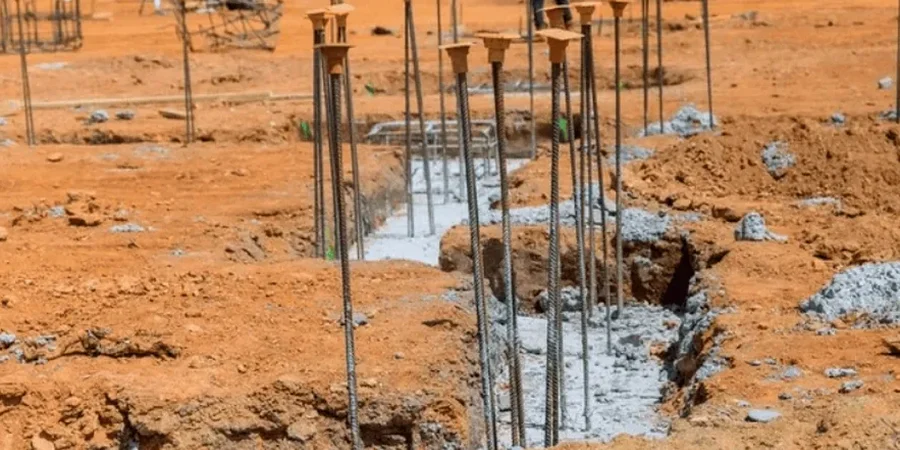
Local geotechnical conditions in Carlow
A commercial building on the Athy Road went to tender with a pile foundation design based on a single borehole that hit rock at 4 metres. The contractor priced the job, mobilised, and found rock at 9 metres on the opposite corner of the site. The variation claim ran to five figures, and the programme slipped by three weeks. Carlow's glacial till is erratic; lenses of sand and gravel sit within the clay matrix, and the rockhead surface is uneven, shaped by pre-glacial erosion. A pile foundation design that doesn't investigate the extremes of the site will catch someone out. We recommend a minimum of three investigation points for any piled structure in Carlow, with one pushed deeper to confirm the rock quality beyond the socket zone. The cost of extra boreholes is trivial next to a piling variation, and the data protects both the designer and the contractor.
Our services
Our pile foundation design workflow in Carlow moves from the drill rig to the lab to the design report. Every step is calibrated to the local ground conditions.
Borehole drilling and rock coring
Cable percussive and rotary coring rigs to penetrate Carlow's glacial till and recover limestone cores for logging, photography, and point load testing.
Laboratory testing programme
Triaxial CU, oedometer consolidation, and unconfined compression tests on till and rock samples, all under our ISO 17025 accredited scope.
Pile capacity and settlement analysis
Axial capacity calculations using the α-method for clays, β-method for granular layers, and end-bearing on rock, with t-z curve settlement prediction.
Pile integrity and dynamic testing
We specify and supervise PDA testing during driving and PIT low-strain integrity tests after installation to confirm the as-built condition matches the design.
Questions and answers
How much does a pile foundation design cost for a project in Carlow?
For a typical project in Carlow, the pile foundation design, including the ground investigation, lab testing, and the geotechnical design report, ranges from €1,440 to €6,540. The spread reflects the number of piles, the depth of the boreholes, and the complexity of the ground. A small extension with four piles costs less; a multi-storey building with a full investigation and dynamic pile testing sits at the higher end.
How do you determine the socket depth into the limestone in Carlow?
We log the rock core to measure the Rock Quality Designation (RQD) and fracture spacing. The socket starts once we hit competent rock with an RQD above 50% and continues for a minimum of 0.6 metres or three times the pile diameter, whichever is greater. Point load index tests on the core confirm the unconfined compressive strength, and we check that the socket can transfer the design load without excessive settlement.
What is the typical pile type used for Carlow's ground conditions?
Continuous flight auger (CFA) piles are common because they suit the stiff till and can be drilled to rock quickly without casing in most locations. Where the till is thinner and rock is shallow, driven precast concrete piles are a cost-effective alternative. We advise on the pile type based on the ground model, access constraints, and noise sensitivity of the site.