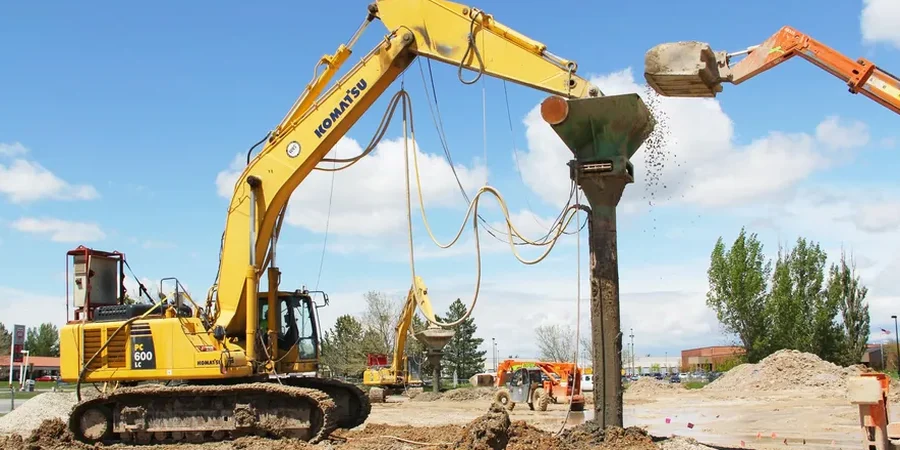
A recurring issue on construction sites across Carlow is assuming that a standard roller will densify a deep bed of loose granular fill. When the target is bearing capacity at depth and the water table sits just a few metres below ground level, surface compaction simply cannot transmit enough energy to the lower layers. We see this mismatch on brownfield plots near the River Barrow and in the industrial estates off the Athy Road, where made ground extends well beyond the influence depth of conventional equipment. The solution requires a vibrocompaction design that accounts for probe spacing, vibration frequency, and the specific grain-size distribution of the material. A well-calibrated scheme can raise relative density from below 40% to over 75%, eliminating the risk of differential settlement under slab-on-grade or shallow footings. In Carlow’s mixed alluvial and glacial soils, we often combine the vibro treatment with a prior CPT test campaign to map the exact depth of loose zones before designing the compaction grid.
Depth-controlled vibrocompaction in Carlow’s floodplain gravels has consistently moved relative density from Dr = 35 % to Dr = 78 % in our post-treatment CPT verification logs.
Methodology applied in Carlow
Local geotechnical conditions in Carlow
Carlow’s population has grown by over 8% between the 2016 and 2022 censuses, driving a wave of housing and logistics developments on former agricultural land along the town’s eastern edge. Much of this ground contains uncompacted fill placed decades ago without engineering control, occasionally intermixed with organic lenses from old drainage ditches. Skipping a proper vibrocompaction design on these sites leads to total and differential settlements that can exceed 50 mm within the first three years of service, cracking partition walls and distorting door frames in residential blocks. The financial exposure is not limited to repair costs; a failed floor slab in a pharmaceutical or food-processing unit near the Carlow business park can halt production for weeks. Our approach reduces this risk by tying the compaction specification to a settlement-limit criterion — typically 25 mm for flexible slabs and 15 mm for rack-supported industrial floors — and validating it through load tests on the treated platform.
Our services
Our vibrocompaction design package for Carlow sites covers the full workflow from field investigation through to post-treatment verification. The two core services are structured to match the typical project phases in the region.
Vibrocompaction Design and Grid Optimisation
We produce a site-specific treatment plan that defines probe spacing, penetration rate, vibration frequency, and hold time per stage. The design is based on grain-size analysis, in-situ density logs, and the groundwater profile recorded at the Carlow site. We deliver a method statement with a compaction point layout, acceptance criteria for relative density, and a verification schedule aligned with EN 14731.
Post-Treatment Verification and Settlement Analysis
After the compaction rig has completed the grid, we execute a programme of CPT or SPT soundings at pre-agreed locations to confirm that the target relative density has been achieved. The field data feeds into a settlement forecast under the design load, giving the structural engineer a verified subgrade modulus for slab or foundation design in Carlow.
Questions and answers
What soil types in Carlow respond best to vibrocompaction?
Clean sands and gravelly sands with less than 12 to 15% silt content respond very well. The glacial outwash and river terrace deposits along the Barrow valley, where D50 typically falls between 0.5 and 5 mm, are ideal candidates. Soils with higher fines or significant organic content usually require a different ground improvement method.
How much does a vibrocompaction design for a typical Carlow site cost?
For a site investigation and vibrocompaction design package covering a plot up to 2,000 m² in Carlow, the fee generally ranges from €1,260 to €5,170 depending on the number of CPT soundings required and the complexity of the ground profile. Larger industrial plots or sites with highly variable fill may extend beyond this range.
How long does the design phase take before the rig can mobilise?
Once the field investigation data is complete, the design and method statement are typically ready within 7 to 10 working days. This includes the compaction grid layout, the stage-by-stage treatment sequence, and the verification protocol.
Is vibrocompaction design in Carlow subject to any specific regulatory approval?
The design itself is not subject to separate regulatory approval, but it must comply with EN 14731:2005 and be compatible with the ground investigation report submitted for building control. The verification data becomes part of the compliance documentation for the substructure.