Carlow’s growth along the River Barrow has always been shaped by its underlying ground. The town’s expansion from a medieval stronghold into a modern commuter hub means new housing estates and link roads are constantly being built over river terrace gravels and glacial tills. Any contractor working these sites knows the council will ask for proof that the fill is tight enough. That is where the sand cone density test comes in. It is the straightforward, on-the-spot method for checking compaction in the field, and it meets the requirements of the local authority and the National Roads Authority. Before placing foundations near the Burren or paving a new access road off the N80, getting a verified density reading avoids future settlement headaches. We often pair this with Proctor tests to establish the reference maximum dry density right from the same borrow pit, so the numbers you get on site are directly comparable.
A single failed density test on a road subgrade in Carlow can delay the asphalt crew by three days. We make sure your readings pass the first time.
Methodology applied in Carlow
Local geotechnical conditions in Carlow
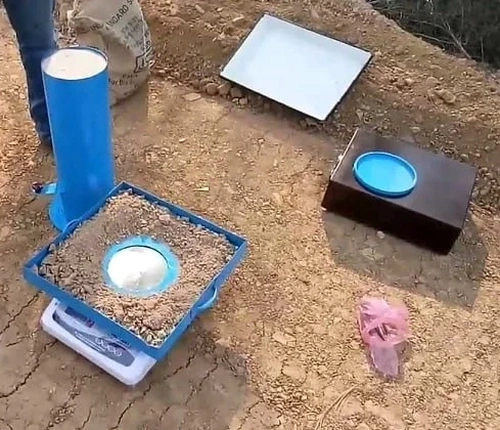
The sand cone apparatus itself is simple: a one-gallon plastic jar, a metal cone with a valve, and a base plate that sits flat on the compacted surface. In Carlow, we use calibrated silica sand sourced from the same supplier every season so the bulk density stays consistent regardless of humidity. But the real risk is skipping the test on a morning when the weather looks dodgy. A light drizzle can add surface moisture that skews the hole excavation, or worse, softens the top 20 mm of a clay fill that was just rolled to spec. If the engineer signs off on a false pass because the test was done too quickly or on a wet surface, that fill could settle under the first heavy truck load. We see this most often on smaller residential sites where the groundworks crew is under pressure to pour footings. The test takes twenty minutes done properly, and that is time well spent.
Our services
Our field density work in Carlow covers the full cycle from lab reference testing to on-site verification. We work directly with site managers and local engineering consultants to keep the earthworks programme moving.
On-Site Sand Cone Density Testing
Field compaction verification for road subgrade, pipe bedding, and foundation backfill in Carlow town and surrounding townlands. We bring the calibrated kit, excavate the test hole, and deliver a percent compaction figure on the spot against your Proctor reference.
Laboratory Proctor Reference Curves
Modified and standard Proctor compaction tests run in our ISO 17025 accredited lab. We determine the maximum dry density and optimum moisture content for your specific site material, so the field sand cone results are accurate and defensible to the resident engineer.
Questions and answers
What does a sand cone density test cost on a Carlow site?
For a standard field density test in the Carlow area, you can expect a cost between €90 and €140 per test location. The exact figure depends on how many points you need in one visit and the travel distance from the lab. We usually recommend a minimum of three tests for a house foundation pad to get a representative spread.
How soon can you be on site in Carlow for compaction testing?
We keep our schedule flexible for local work. For sites within Carlow town, we can typically have a technician on the ground the same day or the next morning after your call. We know the earthworks crews move fast, so we do not hold up the roller.
Is the sand cone method accepted by Carlow County Council?
Yes, it is the standard field method referenced in the NRA Specification for Road Works and is accepted by Carlow County Council engineers for earthworks verification on public and private projects. We provide a signed report with the test location, depth, moisture content, and percent compaction relative to the lab Proctor value.
Can you test crushed stone base with the sand cone?
You can, but we treat it carefully. With coarse aggregate, the sand from the jar can migrate into the voids and give a slightly high volume reading. We use a larger base plate and a fine-graded calibration sand to minimize this error. For very open-graded drainage stone, we often suggest a water replacement method instead, but the sand cone works well for standard Clause 804 road base in Carlow.