Carlow sits at roughly 55 metres above sea level, straddling the River Barrow. Most of the town rests on a mix of glacial till and alluvial gravels that shift from well-graded to borderline cohesive within a single site. The Proctor test gives the contractor a hard number: the moisture content that delivers maximum density for a given compactive effort. Without it, you are guessing whether the fill under that new industrial unit on the Athy Road will settle or stay put. We run both standard and modified Proctor procedures on material sampled directly from the borrow pit or the cut, then pair the result with field density checks using a nuclear gauge or sand cone density measurements to verify layer-by-layer compliance.
A Proctor curve that looks flat or double-peaked almost always points to a material problem, not a lab error. Chasing density without fixing the soil is wasted fuel.
Methodology applied in Carlow
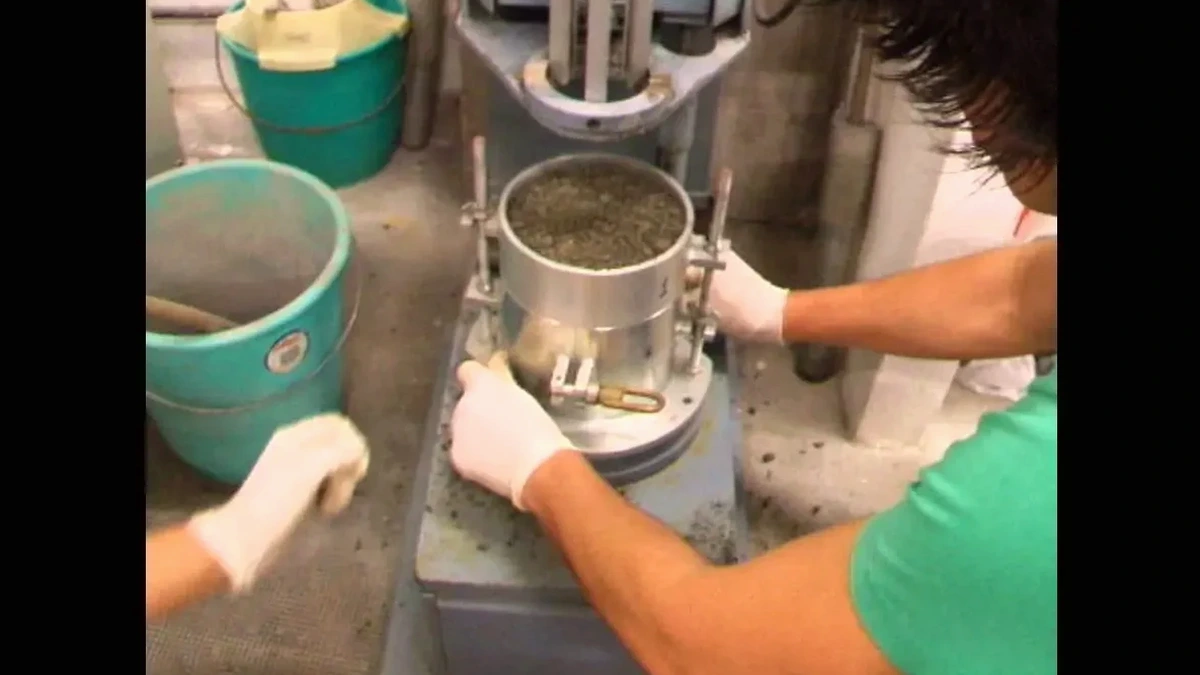
Local geotechnical conditions in Carlow
Carlow's winter water table can sit within a metre of finished grade along the Barrow floodplain, and summer drying cracks open the surface clays two fingers wide. That swing means a Proctor target set in July is completely wrong for material compacted in November. We recommend running a moisture-density family of curves, not a single test, so the site team has a window of acceptable moisture content that reflects the real weather. Compact too wet and you trap pore pressure that bleeds out as settlement later. Too dry and the fill stays fluffy, collapsing the first time a heavy rain soaks through the pavement. On one Carlow school extension we saw density drop 6 % simply because the stockpile was left uncovered during a wet weekend. The Proctor retest caught it before the screed went down.
Our services
We provide two levels of Proctor assessment depending on the fill specification and the expected loading. Both include moisture-density curves with zero-air-voids reference and are issued under our IS EN ISO 17892 laboratory scope.
Standard Proctor – BS Light Compaction
Uses the 2.5 kg rammer over three layers. Suitable for residential plots, landscaping fills, and low-traffic pavements where the specified relative compaction is 95 % standard Proctor or similar. We process the sample to remove particles larger than 20 mm and report the curve within three working days.
Modified Proctor – BS Heavy Compaction
Applies the 4.5 kg rammer over five layers. Required for motorway embankments, industrial slabs, and any fill under dynamic loading. The higher effort pushes the curve up and left, giving a higher maximum dry density at a lower optimum moisture. We run this in parallel with CBR when the pavement design calls for both.
Questions and answers
How much does a Proctor test cost in Carlow?
A single-point standard Proctor typically runs between €110 and €150. A full five-point curve, standard or modified, ranges from €160 to €210 depending on sample preparation and whether we need to remove oversize material. Volume pricing applies for projects requiring more than ten curves.
When do I need a modified Proctor instead of standard?
Modified Proctor is normally specified for highway earthworks, heavy industrial floors, and airport pavements. The deciding factor is the design specification: if the engineer calls for 95 % modified Proctor density, you cannot substitute a standard curve. We check the contract documents and advise on the correct effort before starting.
How long does it take to get the Proctor result back?
A standard curve with five points takes two to three working days from sample receipt. We can expedite a single-point check in 24 hours if the material is already characterised and we are only verifying moisture. Large programmes for road schemes we schedule weekly, batching samples to keep the reporting consistent.
What sample size do you need for a Proctor test?
We need about 25 kg of representative material for a standard mould and 40 kg for the large mould used on gravelly soils. The sample must be bagged immediately after excavation and sealed to preserve field moisture. If the fill contains cobbles larger than 37.5 mm we discuss replacement or scalping procedures before testing.