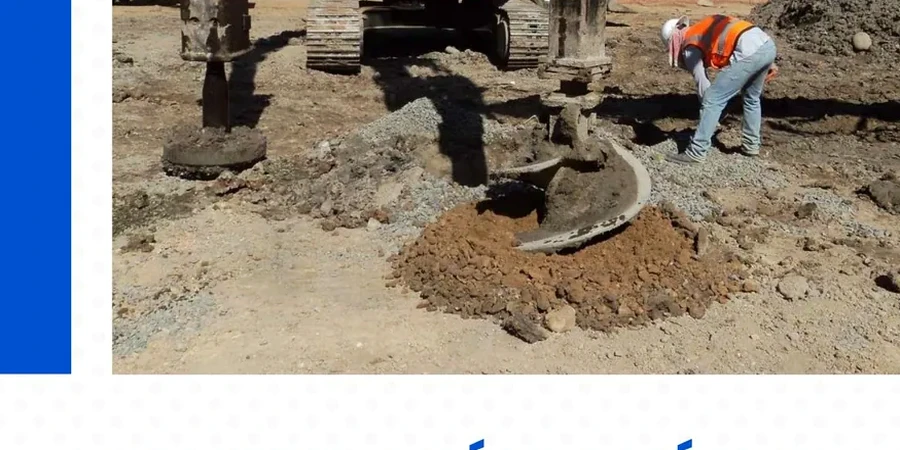
The vibroflot rig sets up on a wet Carlow pasture. A cylindrical poker vibrator penetrates to refusal depth, gravel backfill fed from the hopper. The poker compacts stone in lifts as it's withdrawn. This is the physical reality of stone column design: predicting how that gravel column interacts with the soft silty clay of the Barrow floodplain. Carlow sits on alluvium overlying limestone till. Depths vary sharply across short distances. A 2018 site investigation near the River Burren found 4.2 m of very soft clay before hitting dense glacial deposits. The column must transfer load through that weak layer to competent bearing. We model the composite stiffness of stone plus surrounding soil. Radial drainage from the column accelerates consolidation settlement, reducing post-construction deformation. For sites with very low undrained shear strength, vibrocompaction may be applied as a preliminary densification step before column installation.
A stone column grid at 11 percent replacement ratio can double the composite shear strength of soft Carlow alluvium.
Methodology applied in Carlow
Local geotechnical conditions in Carlow
Carlow's mean elevation is 57 m OD, but the Barrow valley floor drops below 50 m. These low-lying areas combine high groundwater with thick alluvial deposits. The 2009 flood event pushed the Barrow to 3.9 m above its normal level at the Graiguecullen gauge, saturating soils for weeks. Stone columns in these conditions face two failure mechanisms: bulging in the upper two column diameters if the surrounding clay has undrained shear strength below 15 kPa, and punching if the column tip does not reach a competent stratum. We specify a minimum cu of 18 kPa for conventional dry-bottom-feed installation. Below that threshold, a bottom-feed system with compressed air prevents necking. Post-installation, the radial drainage effect of the stone column accelerates primary consolidation settlement, reducing the risk of differential movement between columns and untreated soil.
Our services
We provide a complete stone column design package for Carlow sites, from feasibility assessment through to installation verification.
Column grid design
Determination of diameter, spacing, depth, and area replacement ratio using Priebe's method. Load-settlement curves for each column group.
Composite ground analysis
Calculation of composite shear strength and stiffness parameters for finite element modelling of the treated ground mass.
Installation verification
Zone load testing on single columns and column groups. Post-treatment CPT profiling to confirm column integrity and diameter.
Questions and answers
How much does stone column design cost for a typical Carlow site?
Design fees for a stone column ground improvement scheme in Carlow typically range from €1,260 to €5,020 depending on building footprint, number of column locations, and the depth of soft soil encountered. A small commercial unit on a single plot sits at the lower end. Larger industrial sheds requiring multiple column groups with zone load testing move toward the upper range.
What soil conditions in Carlow are suitable for stone columns?
Stone columns suit the soft alluvial clays and silts found in the Barrow valley. The native soil needs a minimum undrained shear strength of 15-18 kPa for dry-bottom-feed installation. Cohesive soils with cu below that require bottom-feed methods. The technique works well where a competent bearing stratum exists within 6-8 m of ground level.
How is column spacing determined?
Spacing follows from the target area replacement ratio, typically 8 to 18 percent in Carlow conditions. We use Priebe's charts to select the ratio that achieves the required settlement reduction. For a 700 mm diameter column, centres range from 1.8 m to 2.5 m depending on the allowable settlement and bearing pressure.
How do you verify stone column performance after installation?
Verification combines zone load tests on individual columns and post-treatment CPT soundings. The load test applies 150 percent of design load for a minimum 30-minute hold period. CPT profiles run between columns check that the composite ground stiffness has reached design values. Plate load tests on the granular mattress confirm load transfer behaviour.