Comparing the free-draining gravels near the Killeshin Hills with the soft alluvial clays along the River Barrow reveals a stark contrast in seismic response across Carlow. While the town centre sits on relatively stable glacial till, the low-lying floodplain deposits east of the river present a classic setup for cyclic softening. Our geotechnical team focuses precisely on this transition zone, analysing the seismic microzonation parameters that differentiate a stiff site from one prone to pore-pressure build-up. With the Barrow’s historical flood levels saturating the granular lenses interbedded in the silt, the critical layer often lies just 2 to 4 metres below the surface. We integrate CPT test cone resistance and friction ratio profiles to isolate these thin, potentially liquefiable seams that standard borehole logs frequently miss. For projects in the town’s expanding commercial belt, this level of resolution transforms the foundation concept from a conservative over-design into a precisely targeted ground improvement scheme.
A thin layer of silty sand in the Barrow floodplain can double the foundation cost if its liquefaction potential is not identified early.
Methodology applied in Carlow
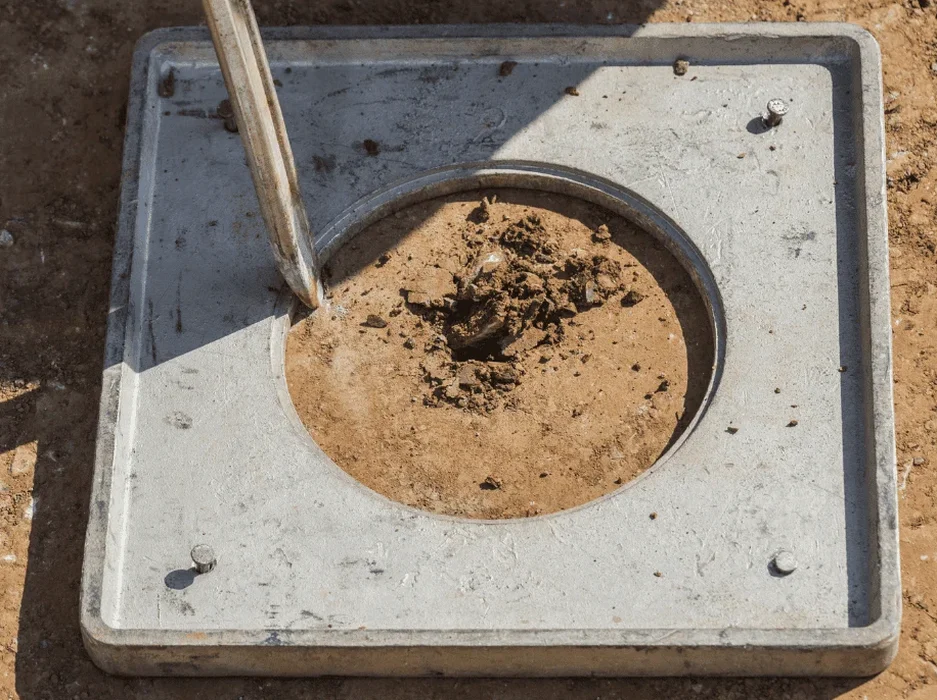
Local geotechnical conditions in Carlow
The most common error we see in Carlow is treating the entire site as a single ground model, ignoring the thin, saturated sandy facies within the alluvium. A contractor will submit a standard bearing capacity calculation assuming a drained response, and the design proceeds without a single cyclic triaxial check. Two years later, after a moderate seismic event centred in the Irish Sea, the floor slab shows differential settlement of 40 millimetres, and the masonry cladding cracks along the damp-proof course. The repair cost dwarfs the investment in a proper liquefaction analysis. The problem is compounded when groundwater monitoring is skipped: a winter water table at 0.8 metres depth creates a completely different risk profile than the summer level at 2.5 metres. Our field campaigns always include seasonal piezometer readings to bound the worst-case pore-pressure scenario.
Our services
We deliver a phased assessment adapted to the project scale, from desktop screening to advanced numerical analysis.
Desktop Screening & Site Classification
Review of GSI Quaternary mapping, historical borehole logs, and groundwater records to assign a preliminary Eurocode 8 ground type and flag potential liquefiable horizons before a single rig mobilises.
Field Investigation & Index Testing
SPT and CPTu campaigns with high-frequency sampling across the suspect depth range, paired with Atterberg limits and grain size distributions to quantify fines content and plasticity characteristics for the cyclic resistance ratio.
Numerical Triggering & Consequence Analysis
Calculation of cyclic stress ratio (CSR) versus cyclic resistance ratio (CRR), factor of safety contours by depth, and post-liquefaction settlement estimates using the Ishihara-Yoshimine chart.
Questions and answers
Is liquefaction really a concern in Carlow given Ireland’s low seismicity?
Seismicity is low but not zero. Eurocode 8 assigns a design ground acceleration of 0.063g for the Carlow region, which is sufficient to trigger excess pore pressure in loose, saturated silty sands. The critical combination is the soil condition, not just the earthquake magnitude. Several sites along the Barrow floodplain exhibit the gradation, density, and water-table depth that require a formal liquefaction screening under Irish building regulations.
What ground investigation data do you need to perform the analysis?
We require SPT N-values with depth, or CPT cone resistance and sleeve friction, from boreholes or soundings that penetrate the alluvial sequence. Grain size distributions and Atterberg limits are essential to determine fines content and plasticity. A reliable groundwater level measurement, ideally from a standpipe piezometer installed for at least 48 hours, is mandatory.
How much does a liquefaction analysis cost for a single residential plot in Carlow?
For a standard residential plot with two boreholes and a liquefaction triggering report, the cost ranges between €2,140 and €3,470. The final figure depends on the depth to rock, the number of SPT samples requiring laboratory classification, and whether a CPTu sounding is added to refine the cyclic resistance profile.
What happens if the analysis shows the soil is liquefiable?
We evaluate the factor of safety and the expected settlement. If the settlement exceeds the structure’s tolerance, we propose a ground improvement strategy. This can range from densification with vibrocompaction or stone columns to a rigid inclusion grid, depending on the layer thickness and proximity to existing buildings. The improved ground is then re-tested to confirm the treatment’s effectiveness.