Carlow sits at roughly 52.8 degrees north, on a landscape shaped by the last glaciation: glacial till overlying Carboniferous limestone. With a population nearing 30,000 and growing, we see more residential and light commercial development pushing into areas where the till mantle is thin and bedrock lies shallow. The immediate question for any new build becomes whether a shallow foundation system can work without excessive excavation. Our team has designed pad and strip footings across the town and surrounding townlands — from the Barrow valley to the upland margins — and we know that getting the bearing stratum right from the first test pit saves thousands in redesign later. In many Carlow sites, competent bearing is available within a metre or two, but verifying that with a targeted ground investigation and a proper SPT drilling programme makes all the difference between a straightforward build and a costly surprise.
A shallow foundation in Carlow's glacial till can carry 100 to 200 kPa safely — but only if the ground investigation captures the real variability of the deposit.
Methodology applied in Carlow
Local geotechnical conditions in Carlow
The glacial till across much of Carlow is a lodgement till — dense, overconsolidated, and generally competent — but it is not without its quirks. The biggest risk we see in shallow foundation design is not global bearing failure but differential settlement caused by lensing: pockets of softer, wetter silt or sand within the till mass. In the Barrow valley, alluvial deposits overlying the till can complicate the picture further, introducing compressible layers that a shallow footing must either penetrate or be designed to accommodate. Radon gas is another distinctly Irish consideration; Carlow falls within areas where radon precautionary measures apply, so our foundation designs routinely integrate gas membrane detailing and underfloor ventilation pathways without compromising geotechnical performance. Frost depth is modest by European standards — typically 450 to 600 mm — but omitting that embedment on a silty subgrade can lead to heave damage after the first severe winter. Our designs always specify a minimum founding depth tied to the fines content of the bearing stratum.
Our services
Our shallow foundation design service in Carlow covers the full chain from desk study through to construction verification. Every package is tailored to the specific ground conditions and the structural requirements of the project.
Bearing capacity verification
Analytical and empirical bearing capacity assessment using SPT, CPT, and laboratory strength data, calibrated to the till or bedrock profile encountered on site.
Settlement analysis
Immediate and consolidation settlement prediction using drained stiffness parameters. We model layered ground to flag differential settlement risks before they become site problems.
Foundation dimensioning and detailing
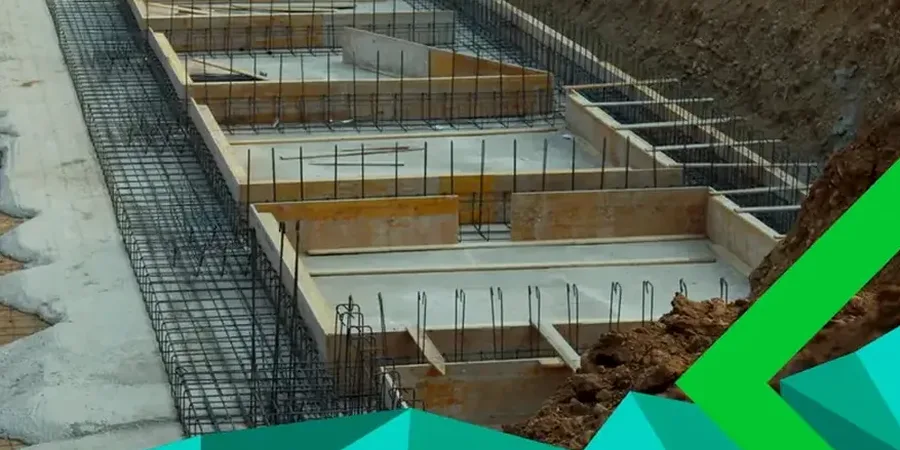
Pad and strip footing sizing, reinforcement schedules, and concrete specification to BRE SD1 for sulphate and chemical ground aggressivity.
Construction phase inspection
Founding stratum verification during excavation, bearing surface approval, and liaison with the assigned certifier to close out the geotechnical design assumptions.
Questions and answers
What does shallow foundation design cost for a typical house in Carlow?
For a single residential dwelling in Carlow, a complete shallow foundation design package — covering ground investigation specification, bearing capacity and settlement analysis, and detailed footing drawings — typically falls between €1,790 and €2,470. The final figure depends on site access, the number of trial pits or boreholes required, and whether additional laboratory testing is needed to characterise variable till conditions.
How deep do footings need to be in Carlow to avoid frost heave?
We specify a minimum founding depth of 450 to 600 mm below finished ground level, depending on the fines content of the bearing stratum. Silty tills warrant the deeper end of that range. The depth is measured from the external finished surface, so landscaping plans matter at the design stage.
Do I need a full ground investigation for a small extension in Carlow?
Yes. Even a single-storey extension benefits from at least one trial pit and dynamic probe to confirm the bearing stratum. We have seen extensions on the edge of Carlow town where the till thins unexpectedly, and the footing ends up partly on rock and partly on stiff clay — a classic differential settlement scenario that a quick investigation would have flagged.