Foundations form the critical interface between any structure and the ground beneath it, transferring loads safely while accommodating the specific behaviour of local soils. In Carlow, the importance of robust foundation design cannot be overstated, as it determines the longevity, stability, and safety of everything from single dwellings to multi-storey commercial buildings and agricultural facilities. A thorough understanding of subsoil conditions, groundwater, and potential geohazards is the first step in developing a foundation strategy that meets both structural demands and regulatory requirements. Whether you are planning a new build, an extension, or a retrofit, the foundation type must be carefully matched to the site’s unique profile, making early geotechnical investigation a non-negotiable investment. The category covers a broad spectrum of solutions, from traditional shallow footings to advanced deep foundation systems, each with its own design methodology and application range.
Carlow’s geology presents a varied picture that directly influences foundation choice. Much of the county is underlain by Carboniferous limestone, often mantled with glacial tills deposited during the last ice age. These tills, typically firm to stiff sandy silty clays with varying stone content, can provide good bearing capacity but are frequently heterogeneous. Alluvial gravels and soft silts along the River Barrow and its tributaries introduce zones of lower strength and higher compressibility, demanding careful assessment. Localised pockets of peat or soft organic clays in low-lying areas present a particular challenge, often requiring deeper foundations to bypass these problematic layers. The presence of karst features in the limestone bedrock, although less dramatic than in the Burren, can lead to dissolution cavities and variable rockhead depths, a risk that must be evaluated through appropriate ground investigation for any significant structure.
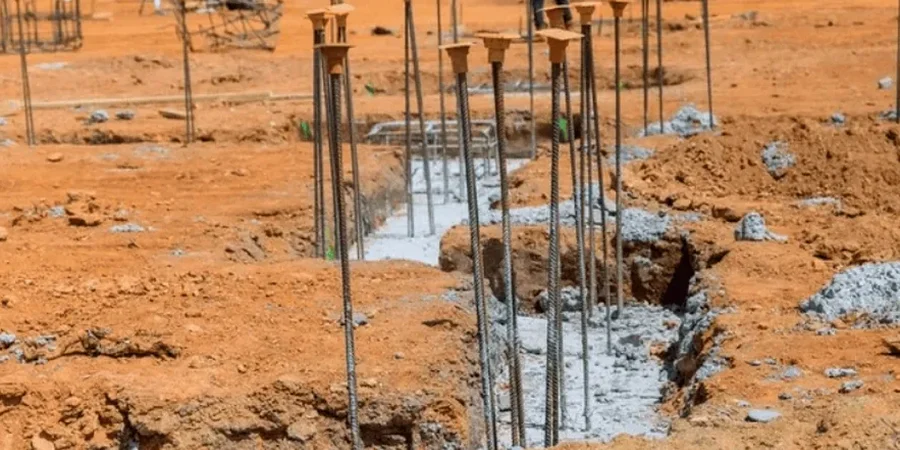
All foundation design and construction in Carlow must comply with Irish and European standards, primarily guided by the Building Regulations (Technical Guidance Document A – Structure) and Eurocode 7 (IS EN 1997-1 and IS EN 1997-2), which governs geotechnical design. The national annexes provide specific parameters for the Irish context. Site investigations are typically carried out to the standards set out in IS EN 1997-2, with the Institution of Engineers of Ireland (Engineers Ireland) and the Geotechnical Society of Ireland providing further guidance on best practice. For residential projects, the HomeBond Technical Manual or equivalent warranty provider standards often dictate minimum acceptable foundation depths and reinforcement for typical strip footings. These regulations ensure a unified approach to safety, requiring that foundations are designed to avoid ultimate and serviceability limit states, including excessive settlement, bearing failure, and heave.
The range of projects requiring specialist foundation input in Carlow is extensive. Standard residential developments often proceed with conventional strip footings, but even these demand proper soil assessment to determine bearing capacity and depth to avoid frost action. Larger commercial and industrial buildings, particularly on brownfield sites or near the river, frequently require more sophisticated solutions. For these, pile foundation design becomes essential when near-surface soils lack the strength or stiffness to support heavy column loads. Agricultural infrastructure, such as silage pits, slurry tanks, and grain stores, imposes unique chemical and structural demands on concrete foundations, requiring durability design alongside geotechnical capacity. Road bridges, retaining walls, and wind turbine bases are further examples where deep foundation expertise is critical to manage both vertical and significant lateral loads.
Available services
Questions and answers
What are the main factors that determine the type of foundation needed for a building in Carlow?
The primary factors are the ground conditions revealed by a site investigation, including soil type, strength, and depth to bedrock. The structural loads from the building, the presence of groundwater, and the risk of settlement or heave are equally critical. Localised issues in Carlow, such as soft alluvial soils near the River Barrow or buried peat pockets, often dictate whether a shallow or deep foundation is required.
How important is a site investigation before starting foundation work in Carlow?
A site investigation is absolutely essential and is a requirement under Eurocode 7 and Irish Building Regulations. It identifies the soil and groundwater profile, allowing the designer to assess bearing capacity and settlement potential. Without this data, any foundation design is speculative and carries a high risk of future structural problems, regulatory non-compliance, and invalidated warranties.
What regulations govern foundation design and construction in Ireland?
Foundation design is governed by the Building Regulations, specifically Technical Guidance Document A (Structure), and must comply with Eurocode 7 (IS EN 1997-1 & 2) and its Irish National Annexes. These standards mandate a limit state design approach to ensure safety against collapse and excessive deformation. For housing, warranty providers like HomeBond also set out detailed minimum technical requirements.
What are the signs of a potential foundation problem in an existing property in Carlow?
Common indicators include cracking in walls, particularly diagonal cracks spreading from window or door corners, doors and windows that begin to stick, and sloping or uneven floors. These can point to differential settlement, often linked to changes in soil moisture, leaking drains washing away fine soil particles, or inadequate original foundation depth. A professional structural and geotechnical assessment is advisable to diagnose the cause.