A warehouse extension near the Burrin River hit unexpected soft clay at 2.5 meters. The contractor had to halt excavation, redesign footings, and lost three weeks. That delay cost more than the original ground investigation budget. Carlow’s geology is like that—a mix of limestone till, alluvial silts along the Barrow and Burrin, and occasional pockets of peat. Getting the soil mechanics study right before breaking ground is the difference between a project that runs on schedule and one that bleeds contingency. Our lab in Dublin processes samples from Carlow sites within 48 hours, giving you shear strength parameters, consolidation data, and bearing capacity figures directly applicable to your foundation design. For deeper profiles in the river corridor we often pair sampling with CPT testing to map soft lenses without disturbing the material.
In Carlow’s river valleys, undrained shear strength can drop below 30 kPa in the alluvium—that single number changes your entire foundation strategy.
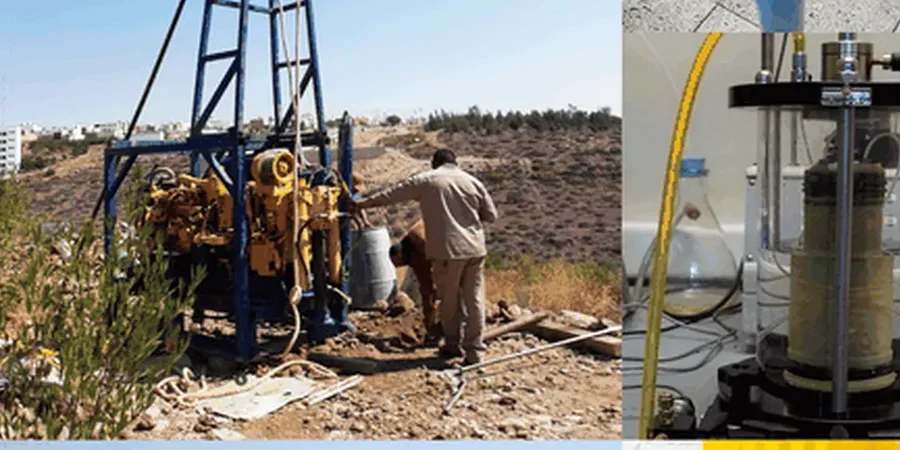
Methodology applied in Carlow
Demonstration video
Local geotechnical conditions in Carlow
Carlow’s expansion over the last two decades has pushed development onto land that previous generations avoided. The old floodplain west of the Barrow, the drumlin edges south of the N80, and the reclaimed areas around the town centre all carry geotechnical baggage. Organic silts and peats compress significantly under load, and differential settlement can crack masonry within the first two years. A soil mechanics study doesn’t just measure strength—it quantifies how the ground will behave over time. We calculate primary consolidation settlement and estimate secondary compression for organic layers. Where the bearing stratum is deeper than 3 metres, we evaluate whether ground improvement or deep foundations make more economic sense. The cost of ignoring these analyses shows up later in underpinning quotes, insurance claims, and tenant disputes. Carlow’s underlying geology rewards the cautious specifier.
Our services
Every soil mechanics study we deliver for Carlow sites includes a face-to-face briefing with the project engineer. We don’t just email a PDF and disappear. You get a walkthrough of the critical parameters, the assumptions behind each derived value, and a clear recommendation on foundation options suitable for the ground conditions encountered.
Full Laboratory Testing Suite
Triaxial compression, direct shear, oedometer consolidation, Atterberg limits, particle size distribution, Proctor compaction, and California Bearing Ratio. All tests run to IS EN ISO 17892 and BS 1377 standards in our accredited Dublin facility.
Foundation Design Parameters Report
A concise geotechnical interpretative report giving bearing capacity, settlement estimates, spring constants for structural modelling, and excavation stability comments. Written specifically for the Carlow ground profile encountered on your site.
Questions and answers
How much does a soil mechanics study cost for a single residential site in Carlow?
For a standard single-house site in Carlow—including a small investigation and the essential lab tests (classification, shear strength, consolidation)—you’re typically looking between €3,130 and €4,400. The spread depends on access conditions, number of samples, and whether triaxial or oedometer testing is required. We can give you a fixed price once we’ve seen the site location and the proposed foundation loads.
Which lab tests are mandatory under Eurocode 7 for a building in Carlow?
Eurocode 7 doesn’t prescribe a fixed list—it’s risk-based. For most Carlow sites on glacial till, you’ll need classification tests (moisture content, Atterberg limits, particle size distribution) as a minimum. If the water table is within foundation depth or soft alluvium is present, we add consolidated-undrained triaxial tests and oedometer consolidation tests. The geotechnical designer specifies the final suite based on the Ground Investigation Report.
What’s the typical turnaround time for lab results on a Carlow project?
Classification and shear box results are usually ready in 3–4 working days. Consolidation and triaxial tests take 5–7 working days because of the saturation and consolidation stages involved. We can split the reporting if you need classification data urgently to keep the excavation moving while the strength tests finish.