The River Barrow cuts through Carlow on its way south, leaving pockets of soft alluvium and gravel terraces that complicate any cut-and-fill operation. When a builder hits grey silt at three metres on the Tullow Road, standard precast L-walls stop being an option. Retaining wall design in Carlow has to reconcile floodplain geology with tight site access, and that starts before the first bulk excavation. We run boreholes and trial pits to pin down the friction angle of the bearing stratum, then model the wall so the stem reinforcement works with—not against—the retained ground. A CPT test in sandy gravel gives us a near-continuous strength profile without losing fines, and when we need to verify compaction behind the heel we specify a sand cone density test to avoid backfill settlement claims later.
A retaining wall is only as reliable as the ground model behind it—get the stratigraphy wrong and you are designing a slow failure.
Methodology applied in Carlow
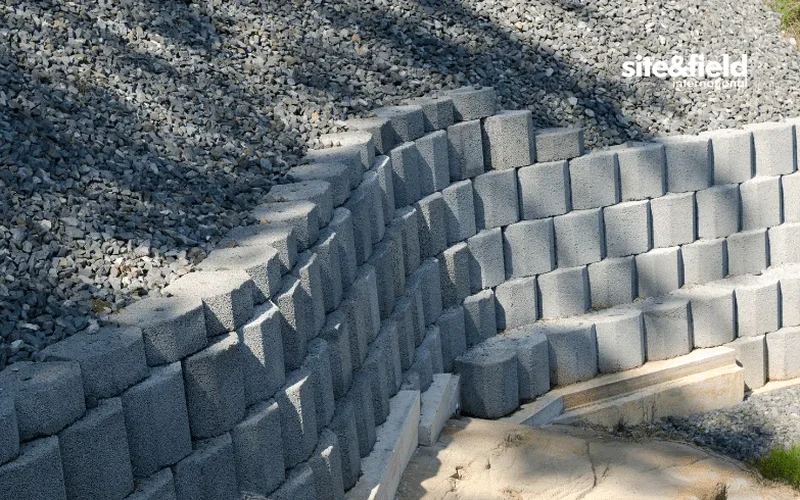
Local geotechnical conditions in Carlow
We reviewed a reinforced-concrete cantilever wall on the Athy Road where the original design assumed a uniform sand backfill. Site investigation revealed a band of plastic silt at the base of the retained cut. That single layer reduced the effective friction angle by eight degrees and pushed the sliding check past the limit state. The contractor had already poured the footing. We redesigned the wall as a propped cantilever using a row of ground anchors drilled into the underlying till, saving the foundation and avoiding a six-week demolition delay. The lesson is simple: Carlow’s subsoil changes fast. A retaining wall design without borehole data is a gamble—one that almost always costs more to fix than the investigation would have cost to perform.
Our services
Our retaining wall design service in Carlow covers the full chain from ground investigation through detailed design and construction-phase observation.
Site investigation for walls
Boreholes, trial pits, and CPT soundings to define the ground model and extract design parameters.
Geotechnical design package
Bearing, sliding, overturning, and global stability checks with full calculation package for Building Control.
Anchored wall solutions
Design of ground-anchor systems where space constraints prevent a gravity or cantilever solution.
Construction-phase observation
Inspection of bearing stratum, backfill compaction testing, and drainage installation verification.
Questions and answers
What retaining wall types are suitable for Carlow’s ground conditions?
Cantilever reinforced-concrete walls on glacial till or gravel terraces work well for heights up to about five metres. Where soft alluvium is present, we often specify a piled foundation or switch to a gravity wall with a wider base. Anchored walls suit tight urban sites along the Barrow corridor.
Does a domestic garden wall under 1.2 m need a formal design submission?
Structures below 1.2 m are generally exempt from Building Control certification, but Carlow County Council still expects a basic stability check if the wall retains a public footpath or roadway. We can produce a short letter report confirming the wall is self-stable under service conditions.
How much should I budget for a retaining wall design in Carlow?
For a standalone residential wall, the geotechnical investigation and design package typically falls between €1,030 and €3,520 depending on retained height, access constraints, and the number of boreholes required. Commercial schemes with surcharge loading sit at the upper end of that range.
What drainage details do you specify for retaining walls in Carlow?
We require a continuous granular blanket drain behind the stem, minimum 300 mm thick, wrapped in non-woven geotextile. Weep holes at 1.5 m centres drain to a collector pipe at the base. For clay backfill, we increase the drain thickness and add a geocomposite drainage layer against the wall.
How long does the design process take from instruction to issued drawings?
Site investigation takes one to two days on site plus two weeks for lab testing. Design and drawing production follows within ten working days after lab results. A typical residential wall package is ready for Building Control submission four to five weeks from instruction.