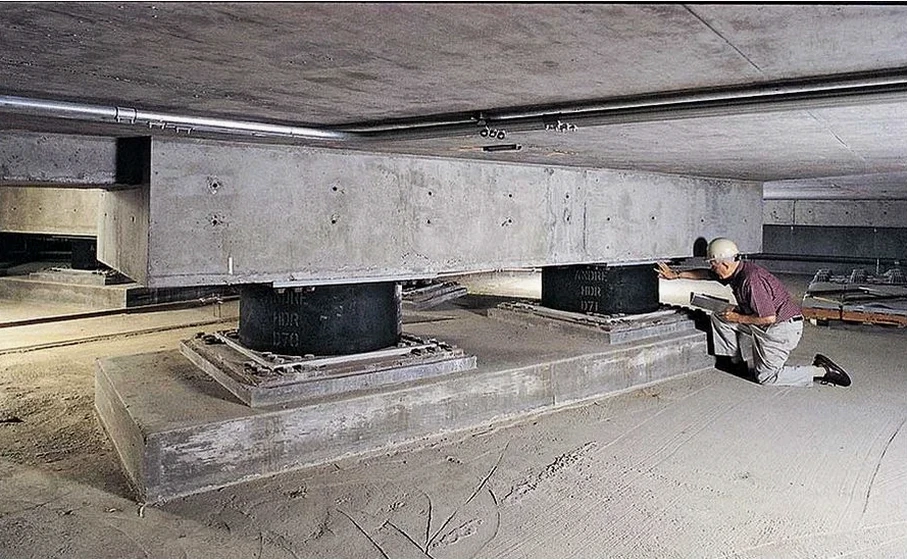
In Carlow, many of our first conversations with architects start with a quick look at the bedrock map. The underlying geology around the River Barrow is predominantly limestone overlain by glacial till, which gives us a reasonably competent bearing stratum but also introduces a stiffness contrast that can amplify certain seismic waves. We have learned that relying solely on ductile detailing in reinforced concrete frames does not always address the drift limitations that matter for post-earthquake occupancy. That is why we incorporate base isolation seismic design into projects where operational continuity is a priority, particularly for healthcare facilities and emergency response centres. The principle is straightforward: decouple the superstructure from ground motion by inserting flexible bearings at foundation level. But the execution demands a rigorous understanding of local soil dynamics, which we validate through complementary MASW testing to confirm shear wave velocity profiles and seismic refraction surveys to map bedrock depth across the site before finalising isolator properties.
A well-designed isolation system shifts the fundamental period of a Carlow building from the earthquake's dominant energy range, cutting spectral acceleration demands by 50 to 70 percent.
Methodology applied in Carlow
Demonstration video
Local geotechnical conditions in Carlow
A mistake we still see on retrofit projects in Carlow is treating base isolation as a bolt-on solution without verifying the existing foundation's capacity to transfer eccentric loads. When a lead-rubber isolator yields under a design-basis earthquake, it generates a restoring force that the original pad footing or strip foundation was never sized for. We have walked onto sites where the original 1960s concrete showed carbonation depths of 40 millimetres, and nobody had budgeted for underpinning before isolator installation. Another common oversight is ignoring the vertical stiffness of the isolators: a stiff superstructure on soft isolators can exhibit rocking modes that amplify vertical accelerations in the corners. Our team addresses this early by running a coupled soil-structure interaction model that includes the isolator nonlinearities, rather than assuming a fixed-base condition and applying a blanket reduction factor. The cost of correcting these issues mid-construction in a town like Carlow, with its narrow street access and tight site boundaries, far exceeds the upfront investment in a proper base isolation seismic design study.
Our services
Our base isolation seismic design work in Carlow spans three interconnected phases, each building on the last to deliver a coordinated isolation strategy.
Site-specific seismic hazard analysis
We compile probabilistic and deterministic hazard spectra for Carlow using the Irish Seismic Network catalogue and European SHARE project data, then deaggregate to identify the controlling magnitude-distance scenarios that drive isolator displacement demands.
Nonlinear isolator modelling and prototype specification
We build three-dimensional models in OpenSees or ETABS with nonlinear link elements calibrated to manufacturer test data, running seven pairs of ground motions scaled to the site spectrum and checking all service-level and MCE performance criteria.
Foundation interface and moat detailing
We design the load path from isolator to existing or new foundations, including shear keys, moat wall reinforcement, and flexible utility connections, and coordinate with the structural engineer to ensure diaphragm continuity above the isolation plane.
Questions and answers
How much does a base isolation seismic design study cost for a building in Carlow?
For a typical low to mid-rise structure in Carlow, a complete base isolation design package including site-specific hazard analysis, isolator specification, and foundation interface detailing falls within a range of €3.890 to €7.750, depending on the number of isolators, the complexity of the ground motion records required, and whether prototype testing oversight is included. We provide a fixed-fee proposal after reviewing the architectural plans and the site investigation report.
Is base isolation practical for a two-storey residential extension in Carlow?
Technically it is possible, but the cost-benefit ratio rarely justifies it for small residential projects unless the building contains high-value contents or serves a critical function. We usually recommend base isolation for buildings of three storeys or more where operational performance after an earthquake is a contractual or regulatory requirement, such as schools, hospitals, or data centres.
How do you coordinate the isolator installation with the Carlow contractor's construction sequence?
We prepare a step-by-step installation procedure that the contractor follows, starting with casting the lower anchor plates into the foundation, then mounting the isolators, and finally forming the upper pedestals before the superstructure formwork begins. We attend the site during critical pours and verify bolt tension and levelling to within a 3-millimetre tolerance, which is essential for the isolators to perform as modelled.
What happens to the isolators in Carlow's wet winter climate over time?
The rubber compounds in high-damping and lead-rubber bearings are formulated with antioxidants and waxes that protect against ozone and moisture degradation. We specify a minimum 20-millimetre cover to steel plates and a protective wrapping for the lead core. The moat is drained to prevent ponding, and we recommend a visual inspection every five years, which is straightforward given Carlow's moderate temperature swings.