A common misstep in Carlow's construction sector is treating a slope stability assessment as a simple tick-box exercise, particularly on the subtle gradients of the River Barrow valley. The reality is that the seemingly stable glacial till and alluvial deposits that characterize much of Carlow town and its rural periphery are susceptible to progressive failure when pore water pressures build after prolonged rain. Oversteepening a cut for a new housing development on the Tullow Road or underestimating the surcharge on an embankment near the River Burren can trigger a shallow landslide that halts a project for months and leads to significant financial overruns. A rigorous geotechnical investigation, moving beyond visual inspection to quantify shear strength parameters, is the only way to understand the true factor of safety of a slope in this specific geomorphological context. When dealing with the laminated silty clays found in many Carlow sites, we often recommend integrating in-situ permeability testing to build a reliable groundwater model, which is the single most critical input for any credible stability model.
A slope's failure is rarely sudden; it is the culmination of a long process of pore pressure accumulation that a Eurocode 7-compliant analysis is designed to foresee.
Methodology applied in Carlow
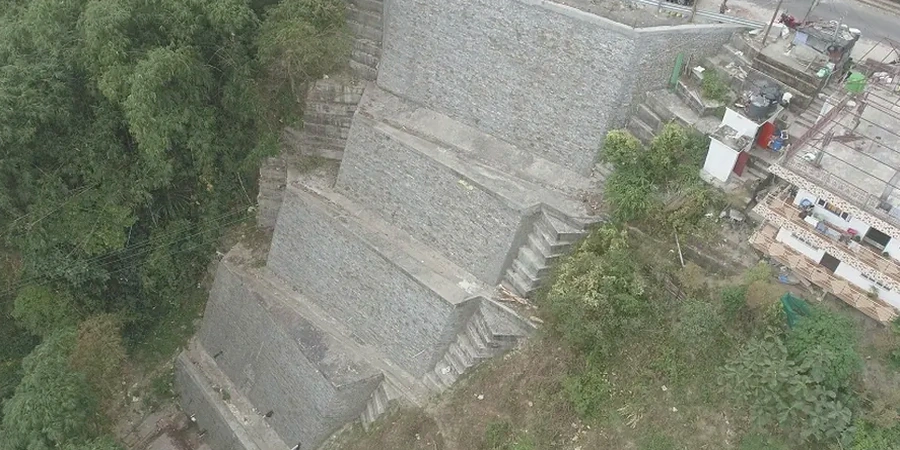
Local geotechnical conditions in Carlow
The Irish National Annex to EN 1997-1 mandates specific partial factors for slope stability that are particularly relevant in Carlow due to the prevalence of low-plasticity silts that can rapidly lose strength when saturated. Ignoring this local geotechnical reality creates a latent liability that becomes catastrophic during the kind of persistent, multi-day rainfall events common in Ireland's southeast. A slope failure here doesn't just mean a repair bill; for commercial developers, it often triggers an environmental compliance review by the local authority if sediment runoff affects a tributary of the Barrow or Slaney. Our analysis explicitly quantifies this risk, modeling the transition from peak to residual shear strength to determine if a landslide would be a slow creep or a rapid flow. This level of detail allows us to specify a target factor of safety that is neither dangerously low nor wastefully high, directly impacting the cost-efficiency of projects from the new Carlow Bypass embankments to private residential cuts in Graiguecullen.
Our services
The varied topography of County Carlow, from the Blackstairs Mountains' foothills to the Killeshin plateau, demands a tailored suite of analytical and remedial services. We provide a complete technical pathway from initial reconnaissance to final construction oversight.
Back-Analysis of Existing Slopes
For distressed infrastructure or pre-existing landslides in Carlow's glacial deposits, we perform back-analysis to calibrate in-situ strength parameters. This forensic approach reveals the controlling failure mechanism and allows for a highly calibrated design of remedial works, such as drains or retaining structures.
Design of Slope Reinforcement
Translating analysis into actionable design, we specify soil nailing layouts, rock bolting patterns for weathered bedrock, and high-strength geogrid reinforcement for embankments. All designs are verified against both global and internal stability failure modes.
Construction-Phase Monitoring
During earthworks near sensitive receptors like the River Barrow, we deploy inclinometers and piezometers to track slope movement and pore pressure in real time. This observational method allows for design adjustments on the fly, ensuring safety without unnecessary construction delays.
Questions and answers
What is the typical cost of a slope stability analysis for a single-family home site in Carlow?
For a residential project on a sloping site in Carlow, a comprehensive analysis typically ranges from €1,150 to €3,870, depending on the slope height, access constraints, and the number of boreholes required to build a reliable ground model.
Does Carlow's low seismic risk mean I can ignore dynamic slope stability?
While Carlow is in a low seismicity region per the Irish National Annex, a pseudo-static analysis is still a prudent check for critical infrastructure or slopes exceeding 10 meters. The analysis confirms that the static design is the governing case, but it provides essential documentation for regulatory compliance and long-term insurance requirements.
How do you model the interface between the glacial till and the limestone bedrock?
The till-bedrock contact in Carlow is often a zone of high groundwater flow and reduced shear strength. We model it as a distinct material layer with residual strength parameters derived from ring shear tests, not just as a rigid boundary. This captures the potential for a translational failure plane during heavy recharge events.
Can you analyze a slope that has already started moving?
Yes. For an active slow-moving landslide, we deploy inclinometers to find the depth of the shear surface. We then run a back-analysis to determine the operative shear strength. This residual strength value becomes the basis for designing the permanent stabilization solution, ensuring the repair works with the current ground state, not against it.