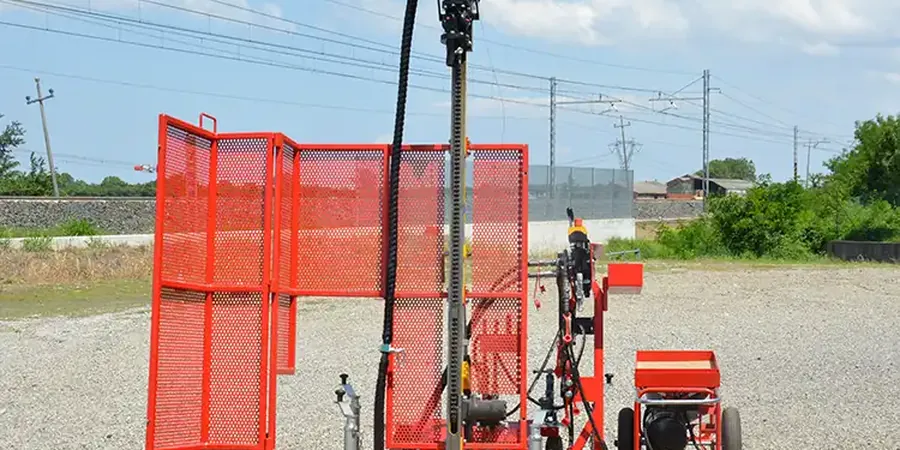
The automatic trip hammer on our Dando Terrier rig cycles at 62 blows per minute when we mobilize to Carlow sites, dropping a 63.5 kg mass through a precise 760 mm free fall onto the drill string. That mechanical rhythm, governed by BS EN ISO 22475-1:2006, generates the N-value that every structural engineer in County Carlow depends on when designing foundations on the region's complex glacial deposits. The split-spoon sampler retrieves 450 mm of physical soil from each test interval, and our crew logs recovery, color change, and water table strike immediately at the borehole collar. In Carlow's mixed terrain, where limestone bedrock can appear anywhere from 1.5 meters to over 15 meters below ground level, accurate blow count interpretation separates a straightforward pad footing from an expensive rock socket. We run the SPT every 1.0 to 1.5 meters through overburden and stop at practical refusal, typically 50 blows for less than 150 mm penetration, to define the bearing stratum. When the sampler comes up with stiff grey-brown till packed tight against the shoe, we know the ground is working in your favor. For sites where continuous profiling adds value, we often pair SPT drilling with a CPT test to capture pore pressure response in the silty transition zones common near the River Barrow floodplain.
In Carlow's glacial till, a corrected N60 above 30 doesn't just mean dense ground — it means a bearing capacity exceeding 300 kPa and a settlement profile measured in millimeters, not centimeters.
Methodology applied in Carlow
Local geotechnical conditions in Carlow
We have pulled split spoons in Carlow where the N-value jumped from 12 to refusal in under a meter — that is the signature of erratic boulders embedded in the till, and a clear warning that interpolating bearing capacity from wide-spaced probes can lead to differential settlement. The Barrow Valley contains pockets of soft alluvial silt at depths of 4 to 7 meters, and a design based solely on shallow SPT data without probing through the compressible layer risks long-term consolidation that shows up as cracks in blockwork years after handover. Another local pattern we recognize immediately: low blow counts in the weathered upper zone of the limestone bedrock, which inexperienced loggers sometimes misinterpret as stiff clay, leading to an underestimate of pile toe capacity. Our field technicians log the cuttings, check for calcareous reaction with HCl, and flag any ambiguity before the log leaves the site. The investment in a thorough SPT campaign across the footprint of the structure, rather than a single borehole at one corner, costs a fraction of the remedial underpinning that becomes necessary when the hidden soft spot is missed.
Our services
Our SPT investigation service in Carlow is built around rapid mobilisation to sites across the county, from Carlow town centre to Tullow, Borris, and the M9 corridor. We coordinate traffic management, underground service clearance, and laboratory scheduling so you receive a complete factual report without chasing subcontractors.
Borehole SPT with Machine-Drilled Holes
Track-mounted or trailer rig access, continuous SPT sampling at 1.0–1.5 m intervals through overburden to refusal or target depth. Includes groundwater monitoring standpipe installation and full log to BS 5930.
Foundation Design Parameter Report
Corrected N60 profiles, undrained shear strength (cu) estimates from Stroud correlation, drained friction angle (φ') from Hatanaka & Uchida, and bearing capacity recommendations for shallow and deep foundations in Carlow's till.
Combined SPT and Laboratory Testing Package
Split spoon samples transferred to UKAS-accredited laboratory for particle size distribution, Atterberg limits, and moisture content — all linked to the SPT log by depth and sample reference number.
Questions and answers
How much does SPT testing cost in Carlow?
For a typical investigation in Carlow involving mobilisation, drilling, SPT sampling, and a factual report, budget between €460 and €590 per borehole depending on depth, access conditions, and the number of test intervals required. We provide a fixed written quote after reviewing the site location and project scope.
How deep do you drill for an SPT in Carlow?
Depth depends on the site geology and the proposed foundation load. In Carlow town we typically drill 8 to 15 meters to reach competent till or limestone bedrock. We stop at practical refusal, defined as 50 blows for less than 150 mm penetration, and we never terminate a borehole without confirming the bearing stratum extends at least 3 meters beyond the planned foundation influence zone.
How soon do I receive the SPT results after the site work?
Digital field logs with raw N-values, groundwater strikes, and sample recovery notes are uploaded within 24 hours of demobilisation. The full factual report, including corrected N60 values, soil descriptions to BS 5930, and borehole location plan with GPS coordinates, follows within 3 to 5 working days.
Can the SPT test tell me if my Carlow site needs piles?
The SPT blow count profile is the primary indicator used to assess whether shallow foundations are feasible or whether deep foundations such as driven piles are required. N-values below 10 in the upper 5 meters, combined with soft alluvial silt, often indicate that a piled solution is more economical than extensive ground improvement. We provide the data; your structural engineer makes the final determination.
What makes Carlow ground conditions different for SPT interpretation?
Carlow sits on the boundary between the Leinster granite batholith and the limestone plain, creating a till matrix that contains both siliceous and calcareous clasts. This mixed mineralogy affects sampler recovery and requires careful logging to distinguish weathered bedrock from stiff clay. The River Barrow and its tributaries also deposit soft alluvium that can produce misleadingly low N-values if not identified as a distinct compressible layer.